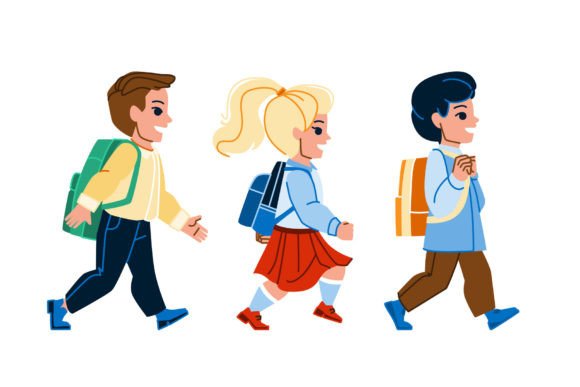
Kid Walk to School Vector: A Practical Asset for Visual Communication and Workflow Integration
When designing educational materials, marketing campaigns, or community outreach assets, visual consistency and thematic clarity matter—especially when communicating values like safety, health, sustainability, or childhood development. The Kid Walk to School Vector is a purpose-built digital illustration asset that supports those goals with precision: a flat, cartoon-style vector depicting elementary-age children—boys and girls—walking to school with backpacks, smiling, in motion. Available in JPG and EPS formats, it’s optimized for scalability, editing, and cross-platform use without quality loss.
This isn’t just clipart. It’s a workflow-aligned resource—designed to integrate cleanly into planning, production, and delivery phases across education, publishing, nonprofit advocacy, and small business branding. Its strength lies in how it functions *within* real processes—not as a standalone image, but as a coordinated element that reinforces messaging, streamlines design decisions, and reduces revision cycles.
Where the Kid Walk to School Vector Fits in Your Process
In practice, this vector rarely appears at the end of a project—it’s most effective when selected early, during the conceptual or wireframing stage. For example:
- Educators building back-to-school newsletters or walk-to-school week toolkits use it during content structuring—placing the vector alongside safety checklists or route maps before final layout.
- Nonprofit teams launching community health initiatives embed it in early slide decks and grant application visuals to establish tone and audience alignment before writing narrative text.
- Freelance designers include it in style guides for K–5 clients—not as decoration, but as a defined visual anchor for color palette, character proportion, and motion direction (e.g., left-to-right flow matching reading conventions).
That early integration prevents misalignment later. If you wait until final export to source imagery, you risk mismatched proportions, inconsistent line weights, or licensing friction—all of which trigger rework. With the Kid Walk to School Vector, compatibility is built in: EPS ensures full editability in Illustrator or Affinity Designer; JPG provides immediate drag-and-drop use in Canva, PowerPoint, or WordPress editors.
How It Interacts With Other Tools and Decisions
The vector doesn’t exist in isolation. Its value multiplies when paired intentionally with complementary resources:
- Typography systems: Pair its clean, rounded outlines with sans-serif fonts like Nunito or Quicksand—both widely available and designed for readability at small sizes, reinforcing the same friendly, accessible tone.
- Color workflows: Since the EPS file includes layered, ungrouped elements (backpacks, hair, shoes, paths), you can batch-replace colors using global swatches—critical when adapting one asset across seasonal campaigns (e.g., “Walk Safely in Fall” vs. “Spring Step Challenge”).
- Accessibility practices: Use the vector’s high-contrast, uncluttered composition as a baseline for alt-text writing (“Two smiling children walking on a sidewalk toward a school building, carrying backpacks”)—a detail that strengthens SEO and inclusivity without extra effort.
It also interfaces directly with decision points. Choosing this vector over a photo-based alternative signals intentionality: you’re prioritizing clarity over realism, scalability over resolution limits, and brand cohesion over stock-generic visuals. That choice cascades—reducing time spent cropping, masking, or adjusting lighting in post-production.
Practical Implementation Tips for Real Workflows
Here’s how professionals actually use it—without overcomplicating things:
For Educators and School Staff
Embed the vector into editable Google Slides templates used district-wide for parent orientation. Because it’s vector-based, staff can resize it for posters, handouts, or digital signage without pixelation—and change backpack colors to match school spirit weeks (blue for “Bulldog Pride,” green for “Eco-Walk Day”). No designer needed.
For Marketers and Small Business Owners
Use the EPS version to create modular social media banners. Duplicate the base scene, then swap background layers (clouds, trees, crosswalks) while keeping characters consistent—building a mini visual library in under an hour. This maintains campaign continuity across Facebook, Instagram, and email headers.
For Content Creators and Bloggers
Insert the JPG into blog posts about active transportation or childhood development—but don’t just drop it in. Annotate key elements: add subtle arrows pointing to footwear (for foot-health tips) or backpack posture (for ergonomic guidance). That turns passive illustration into active explanation.
Factors That Support Long-Term Usability
Sustainability isn’t just environmental—it applies to digital assets too. The Kid Walk to School Vector supports long-term use through several practical features:
- Organization: File names follow clear conventions (e.g.,
kid-walk-to-school-boy-backpack-eps), making them instantly searchable in shared cloud drives or DAM systems. - Efficiency: Layer labeling in the EPS file (e.g., “shadow,” “hair-highlight,” “backpack-zipper”) cuts down on hunting for editable parts—especially useful when multiple team members handle revisions.
- Consistency: Because all characters share proportional guidelines (head-to-body ratio, stride angle), mixing this vector with other school-themed vectors from the same series preserves visual harmony—no manual tweaking required.
- Quality control: Pre-optimized JPG exports include embedded sRGB profiles and 300 DPI resolution, eliminating last-minute “Is this print-ready?” checks before sending files to printers.
And because it’s flat-design—not skeuomorphic or overly detailed—it ages well. You won’t need to replace it every time UI trends shift. It works equally well in 2024 presentations and 2028 annual reports.
Integrating Smoothly Into Your Routine
Adoption is fastest when treated as infrastructure—not decoration. Start by adding the vector folder to your standard project template (e.g., inside a “/assets/illustrations/” subfolder in your Figma or Adobe CC Libraries). Then, build one reusable component: a branded banner layout with fixed margins, typography scale, and the vector anchored at 65% width. Save that as a starter file. Next time you need a walk-to-school graphic, open the template—not a blank canvas.
You’ll also reduce cognitive load by documenting usage rules internally: “All student-facing materials use the Kid Walk to School Vector for consistency—never substituted with photos unless accessibility testing confirms equal comprehension.” That kind of specificity prevents drift and keeps teams aligned.
Finally, track where it adds measurable value. Does using it cut average design time per campaign by 20 minutes? Does it increase click-through on safety flyers by improving scannability? Those aren’t vanity metrics—they’re signals that the asset is functioning as intended: not as a static image, but as a functional part of your communication system.
When chosen deliberately and embedded intentionally, the Kid Walk to School Vector becomes more than illustration—it becomes a quiet multiplier for clarity, efficiency, and trust.