My Doctor Visits Log Book Kdp Interior
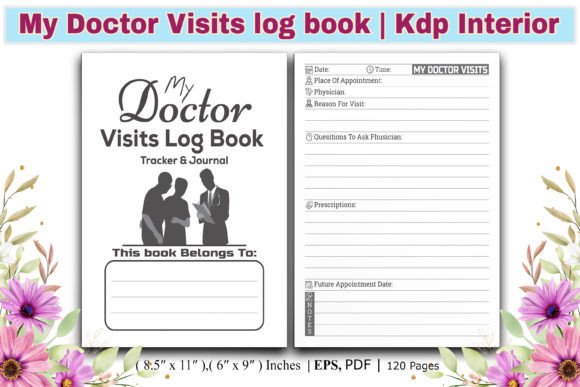
If you're designing a medical log book for KDP—whether for adults tracking chronic conditions, parents managing pediatric care, or educators supporting health literacy in early learning—you need interiors that feel both trustworthy and approachable. My Doctor Visits Log Book Kdp Interior delivers exactly that: a clean, clinically grounded yet warmly human layout built for real-world use. It’s not just a collection of blank pages—it’s a thoughtfully structured 120-page PDF interior (8.5″ × 11″ and 6″ × 9″ versions included), with full bleed support, high-resolution EPS files, and print-ready formatting that meets Amazon’s strict KDP specifications out of the gate.
A Design That Bridges Care and Clarity
This interior leans into quiet professionalism—not sterile minimalism, not cutesy distraction. The typography is legible at a glance: clear sans serif headings paired with generous line spacing and subtle visual cues (like gentle section dividers and consistent icon placeholders) guide users through appointment dates, symptoms, medications, follow-ups, and provider notes. There’s no decorative clutter, but there *is* intention—soft rounded corners on checkboxes, margin notes aligned to left-aligned body text, and a rhythmic grid that supports handwriting without demanding perfection. For kids’ versions like My Doctor’s Visit: A Doctor Book for Kids, the same structural logic applies—just with larger writing zones, friendly icons (stethoscopes, thermometers, smiling faces), and age-appropriate prompts (“What did the doctor listen to?”). It’s editorial design thinking applied to healthcare documentation: functional first, empathetic always.
Where This Interior Truly Shines
You’ll see the strongest impact where clarity, consistency, and credibility intersect. Think physician appointment trackers for senior wellness programs—where readability at 60+ matters. Or baby medical logs bundled with newborn gift sets—where soft color-safe margins and intuitive page flow make scanning a breeze for sleep-deprived parents. It works equally well in university health center handouts, telehealth onboarding kits, or caregiver training materials from nonprofit clinics. Because it’s built as a *system*, not a one-off template, you can scale it across formats: convert a single spread into a printable PDF worksheet, adapt the layout for a bilingual version (Spanish/English side-by-side), or reflow content into a digital Notion template—without losing its core voice.
Typography That Supports, Not Competes
The interior uses a carefully chosen combination of fonts—not flashy, but purpose-built. Headings are set in a sturdy, slightly warm sans serif (think humanist sans, not geometric)—friendly enough for a child’s journal, authoritative enough for a prescription tracker. Body copy opts for a highly legible, open-x-height typeface with generous letter spacing—critical for handwritten entries under low-light conditions or rushed clinic visits. No script flourishes. No condensed caps. Just honest, accessible typography that puts *information* first. That’s why it performs so well in both print and digital previews: no squinting, no misread abbreviations, no second-guessing whether “7 mg” was meant to be “70 mg.”
Practical Tips Before You Upload
Before finalizing your KDP listing, test three things: First, print a physical proof—especially if targeting older audiences or clinical settings. Check contrast between ink and paper stock; some matte finishes mute light grays used for subtle lines. Second, review the EPS bleed files closely. Are all critical elements (page numbers, headers, checkboxes) safely inside the safe zone? KDP rejects files where essential content bleeds off unintentionally. Third, consider pairing this interior with a complementary cover font—not matching, but harmonizing. A soft-serif title font on the cover (like Merriweather or Cormorant Garamond) creates elegant contrast against the interior’s clean sans serif, reinforcing trust without sacrificing warmth.
Licensing & Real-World Use
All assets—including both PDFs and EPS files—are licensed for commercial use. That means you can sell printed copies, bundle them with coaching packages, include them in subscription boxes (e.g., “Health + Habits” monthly kits), or even white-label them for clinics and school nurses—no extra permissions needed. Just remember: while the interior is yours to adapt, the *branding* around it isn’t. Don’t rename it “Dr. Smith’s Official Tracker” unless you’ve added original content, illustrations, or structural changes that meaningfully differentiate it. Authenticity builds authority—and Amazon’s algorithm rewards listings with clear value, accurate tags, and user-focused descriptions.
For designers building multiple KDP health journals, this interior serves as a reliable foundation—not a finished product, but a launchpad. Swap out icons, adjust column widths for different data points (e.g., add allergy tracking for school nurses), or layer in QR codes linking to CDC vaccine schedules. Its flexibility comes from restraint: no over-designed elements competing for attention, no rigid templates forcing unnatural workflows. Just space, structure, and quiet confidence—exactly what good healthcare documentation should feel like.